
Conferences
At our THT 2026 symposium, leading heart failure experts shared updates on the evolving evidence for Baroreflex Activation Therapy, including real-world outcomes from the REBALANCE Registry and insights into the BREATHE-HF and BENEFIT-HF clinical trials.
Watch the presentations to hear the latest on Barostim, including cardiac hemodynamics, real-world outcomes, and ongoing clinical research.
Dmitry Yaranov, MD
Baptist Memorial
So I have twelve minutes and six minute presentation. So I’m not gonna rush through it like I had to do yesterday. But what I’m going to present you today is the on label cohort of REBALANCE Registry. We did do a presentation for the full cohort of REBALANCE yesterday during the late breaker, and I’ll walk you through the on label part of it. This is my disclosures. So as Phil already mentioned, and everyone in this room, I’m sure, is aware that decreased their receptor signaling ultimately is an important step in activate neurohormonal pathways that ultimately lead to heart failure progression. Increased sympathetic output decreased parasympathetic output and ultimately downstream effects of the of this activation. The main mechanism behind neurohormonal blockade is blocking the specific access of those neurohormones. It’s a downstream effect and working downstream. And the concept of baroreflex activation is behind hopefully working complementary with drug therapies by acting upstream prior it gets down there to restore the baroreceptor signaling and ultimately slow down the progression of the disease, improve the outcomes for the patients. So, Baristem itself is a safe extravascular device that is usually surgically implanted. And the idea behind the device is electrical stimulation of carotid baroreceptors that will ultimately result in rebalancing of autonomic nervous system, decreasing the sympathetic output, and bringing back up the parasympathetic output. And what we know by now, it does improve heart failure symptoms. The indication which followed the the FDA label is heart failure with reduced ejection fraction, ejection fraction less than thirty five percent for those patients who receive guideline directed medical therapy with regards to medications and devices. And those who have NYHA class three symptoms, and those with class two symptoms should have prior class three symptoms. And then T ProBNP cutoff for on label cohort, or for patients on label right now, is less than sixteen hundred. So, all the preclinical and clinical data that ultimately culminated with a phase three pre market and post market study proved durable, long term improvement in six minute walk test, quality of life, and YHA class for patients with heart failure with a reduced ejection fraction. So ReBalance is forty five U. S. Sites that got together back in twenty twenty and formed a multi center post market real world study. The first patient was enrolled in twenty twenty, and the last patient was added to the registry in March twenty twenty five. The minimum follow-up for a balanced registry is twelve months, and the last patient is completing the twelve month follow-up this coming March. Actually, not coming, but March. So, to get into the registry, you had to have a Baristem implanted as a standard of care across those sites. And once your implant happened, then you would be able to consent and get into the registry. So, baseline characteristics of those patients, very important to reflect on those and see how they’re different or similar to BHF. You can see that those patients were older. Those patients had NYHA class one and four symptoms that includes the off label cohort. And then certainly, those patients were treated a lot better. Once we dissected the on label cohort itself, you can still see that those patients continued to be older. There’s a more SGLT2 inhibitors. There was only one patient on SGLT2 inhibitors in the whole beta HF trial because of the timing of it. And here, we have up to fifty two percent of patients treated with it. RNA was sixty four point two percent in the similar amounts of MRAs and beta blockers. Again, I’ll repeat the thirty three point six percent of patients had NT proBNP more than sixteen hundred, LVUF more than thirty five, and OHA class one and four. I’m not going to cover the whole cohort in this presentation, but just we’ll talk about those who received Baristem as on label. So, first question and the first remark to make here is although I’m showing you the six month outcomes, truly we’re looking at a three month follow-up post Barastem implant. Because those of you who have not tried this therapy yet, it takes about three months to get the fully titrated device, and ultimately, those patients are only treated for a full three months with maximum titration. The question that everyone asks in the clinical practice, what happens to blood pressure with chronic stimulation? In contrary to with acute stimulation, there is no decrease, no significant change between systolic or diastolic blood pressure, as well as the heart rate after three month support and six month of the follow-up. This is a six month outcome for LVEF and YHA class. And you can see that in the on label cohort, consistent with overall cohort, there was significant improvement in significant change in those three months of treatment and six month follow-up of injection fraction from twenty six point four to thirty point four percent. I invite you in an hour and a half, we have another presentation for a twenty four month follow-up for LVEF. And on the right side of the screen, you can see that majority of the patients improved their NYHA class. And you can see that the amount of patients who with NYHA class one and two symptoms at six month follow-up has virtually doubled from the baseline. Thirty five thirty thirty four percent of patient at least by improved by at least one class from the baseline. So, in summary, compared to BHF, ReBLANCE patients were older with more heterogeneous disease and those including off label use, which reflects the real world practice. Contemporary GDMT was analyzed in this study, and use of ARNI was ARNI and SGLT2 inhibitors was significantly higher in this real world registry than in the BHF trial. Titration of bariciton therapy typically occurs over three months. So truly, the six month follow-up represents a very early experience and only three months of fully titrated device. That’s why we’re very excited to see these numbers that we’ve seen. In this initial six month real world analysis, the REBELANCE on label cohort, baristin was associated with a significant improvement in YHA class and also LVEF. There was no adverse events on systolic and diastolic blood pressure. We expect the full report of rebalance with a twelve month follow-up by this fall. Thank you. Dmitry, you mentioned very interestingly the concept that if we think of this as a titration of therapy like beta blockers, that the full effect at maximum dose in the data you just showed was really only three months. Maybe you can comment, the other piece is that the baseline GDMT did include SGLT2 inhibitors and a fairly high use of four pillars. How do you perceive, other than being excited about seeing the signal, significant improvement in ejection fraction with such a short exposure to therapy? It certainly well, I I pursued it with excitement because we did see quite a few single center experiences from Germany. There was a center a local experience from Southern California, And we did track pretty much very close numbers that we’ve seen in single center. It’s great to be able to reproduce it in the sample like this. And certainly, you know, part of it is to the speed at which ejection fraction separated from three to six month from baseline to six month follow-up is also very encouraging and exciting. Part of it is also goes back into concept of you truly you know how we discuss the need or no need for myocardium for for this type of therapy and I think that this nicely ties into your proposed concept about upstream effect that can complement and enhance GDMT in such a way. And the New York Heart class then seem to parallel the improvement in ejection fraction. Have there been any studies or any correlations between improvement in EF and improvement in symptoms? Or is there that sort of chronic discordance that we see with EF and symptoms? So, know, I can quote my data set that I presented last year here at THT. What we looked at, we looked at the NYHA class assessment and peak VO2 post improvements. So in those correlated pretty well. It was all commerce twenty patients only. So in that data set, those do go hand in hand. And I think, Gabe, you’re going to present a little bit of data about the hemodynamics that you just mentioned. Can you comment about a little bit more detail about what you saw with Barostim and the fundamental hemodynamics that we consider are the genesis of symptoms? Sure. So, we do have we do have a hemodynamic set in our institution as well. And what’s interesting about it, once I produced the first hemodynamic set, we went back to animal studies that we have seen with Baristem that exists and published out there, and I urge you to look at it. And those are the studies looking at comparing acute barrier reflex activation to angiotensin infusion and napride infusion. And just even in this model, animal model, we’ve seen that acute activation of berry flex very tightly mimics the napride infusion. And we did see in humans as well and we have a few cases and don’t see if John is here, but John presented some data as well. It’s decreasing the preload and filling pressures with the lack of drop in the systemic blood pressures. And that’s what we a lot of times will see in our anecdotal cases. Perfect. Thank you very much. Any questions from the audience? Okay. Thank you very much, Dimitri.
Gabriel T. Sayer, MD
Columbia University Medical Center
Well, it’s a real pleasure. Thank you, Phil, and thank you all for joining us. I’m gonna be talking about BREATHE-HF, which is a study that we’re launching this month. We’re very excited about it, so I’ll tell you a little bit about it. So, my disclosures. So, we know the mechanism here. We understand that, right, the the sympathetic activity decreases following barostimulation, parasympathetic activity increases, and we know from BeAT-HF that this translates into a clinical benefit. But, you know, we’re all, I think most of us in this room are heart failure cardiologists, right? So, you know, we always want to know about hemodynamics. And so, is this effect being mediated by hemodynamics? And so, the question we asked is how does baroreceptor activation impact hemodynamics? There is surprisingly little data about this, but hopefully much more to come. So, I’m gonna show you a few cases that have been reported that have looked at this, but sort of the rationale for the study that we propose is to get a better sense of this. So this is recently published looking at indirect hemodynamics, right? So these were echo based hemodynamics and showing improved VA coupling based on echo parameters following Baroreflex Activation Therapy. You can see, it’s hard, I know it’s a little bit hard to read on the graph at the bottom, but you can see that all of the LV and LV parameters that they looked at improved, including stroke volume following therapy. And, if you look at the right, they looked at the VA coupling directly by estimating end systolic elastance and afterload, and basically using the ratio between the two. And so you can see that there was an improvement in this patient. This slide is courtesy of Jonathan Grinstein, has not yet been published, but he looked at some of his advanced hemodynamic measures in patients who had received Barostim. You know, he looks at aortic pulsatility index, he looks at PAPI here, of course, and cardiac power output, and then he has this myocardial performance score. And you can see that there were some super responders here, right? Particularly the patient in blue. The patient in red seemed to have very nice responses to therapy. All of the patients had improvements in their aortic pulsatility index, which is really one of the more important hemodynamic parameters. And if you look on the right side here, this is PV loops that they did from one patient, I think it was the patient in blue, is what John told me. And you can see really significant improvements in the PV loop, which is shifting to the left, and you’re getting increases in your stroke volume without decreases in pressure generation. So, very nice. And they did them both on the left side and the right side. And you can see that the RV PV loop was improved as well. So, nice improvement. And then this is a data that Dan Burkoff provided. This is a patient who was implanted, and then this is kind of reverse ramp almost, So, turned speed, turned down the power output of the device all the way down to zero, and looked at hemodynamic parameters as that was done. So you can see here that as that was done, the wedge pressure goes up, the SVR goes up, your cardiac index drops. Blood pressure, not much change, maybe a slight trend up, but really not much changed. Suggesting, right, that as you’re withdrawing therapy, your hemodynamics are getting worse. This of course is a very acute demonstration, but concerning. He also did pressure volume loops, and again, you see worsening of the pressure volume loop, both the left and the right side, a shift up into the right as therapy is withdrawn. So, very concerning. So, based on this, we wanted to better understand what was the hemodynamic impact of this therapy, and we designed the BREATHE-HF study, so it’s Barostimulation and Reduced Ejection Fraction Assessing Trajectory of Hemodynamics during Exercise. It’s kind of convoluted title, but it comes out nicely with our with our an acronym here, acronym. And and of course, thank you to Morgan Smith for some of these slides. He’s leading the project on our our end. At Columbia, his wife actually designed our logo, so we have her to thank. Uh-oh. Here we go. Okay, sorry. I didn’t realize it was animated. So, this is basically the study scheme, and this is the concept. So, I’m sorry. Oops. There we go. So, we’re gonna enroll patients, and prior to implants, so we’re gonna get baseline data, and that’s gonna include patients wearing a Fitbit device, right? So to collect activity data, and all sorts of heart rate, and heart rate variability data over the one to two month period prior to implant. Patients of course will get an echo at baseline. And then every patient is going to get a right heart catheterization with exercise, as well as a cardiopulmonary exercise test. And in a subset of patients, that will be combined tests, so it’ll be like an invasive CPET, basically. Not every site has the capability to do that. So, sites we’re doing invasive CPET, some sites we’re doing the studies separately, the exercise right heart cath and the CPET. But everyone will get measurement of hemodynamics during exercise. Of course, the patients will get the implant, and we’re gonna have a up to three month titration period, as usual. Patients will be followed regularly during that time period. And then, at the six month period following the end of titration, so somewhere between six and eleven months after entering the study, patients will then get all the tests repeated. So they’re gonna get an echo, they’re gonna get the exercise right heart cath, they’re gonna get a cardiopulmonary exercise test, or perhaps a combined exercise radar cath and cardiopulmonary exercise test, and then we will once again reassess their Fitbit data to see the improvements. So, the primary endpoint that we’re going to look at is the change in exercise wedge pressure. That’ll be obviously measured between the pre therapy point and the post therapy. But we’re gonna look at a bunch of other measures, as you can imagine, including exercise, pulmonary artery pressure, change in peak VO2, change in their step count. We’re gonna be following meds carefully. Patients don’t need to be on completely optimal medical therapy to enter, but of course we’re gonna measure any medical changes along the way, including the ability to uptitrate therapy that you were previously limited to do. And then we’re gonna measure KCCQ scores, because what would a heart failure study be without KCCQ scores? And then we have some exploratory endpoints, talked about heart rate variability, we talked about activity levels, sleep quality, hospitalizations, and we’re gonna measure NT-proBNP. Inclusion exclusion pretty much mirror, you know, it’s the kind of the commercial indication here. You know, obviously we don’t want patients that are too sick to enter this study, and they need to be able to exercise, but other than that, it’s essentially the same indications that have been previously described for implant of the device. And this is again just showing when we’re collecting all the data. So, we’re, you know, have all the ECG echo smartwatch at baseline, and then again at the six months following the titration. These patients will be wearing their Fitbit sort of throughout, so we’ll be able to collect data all along the way. Should have an enormous amount of data. We’ll have to get artificial intelligence to pour through it, or my biostatistician who’s sitting here who’s probably regretting this a lot, he’s gonna have a lot of data to look through. And then this is just showing the Fitbit that we’re going to use, and these are the kind of activity we’re gonna collect, step counts, how many minutes a day they’re active, heart rate, heart rate variability, sleep data, and now they can calculate this estimated VO2 max, so we’ll use that as well. So, I mentioned that all the patients will get a CPET, all the patients will get exercise right at a cath. At least twenty of the patients will have those done at the same time. And obviously, we’re gonna combine all this data, but we’ll also look at that separately, because there are some difference between doing your CPET in the cath lab versus not doing the cath lab. And so, we’ll look at both of those things sort of combined, and then as individual tests. And you can see all the things that we’re gonna measure here, is the standard labs and variables that are measured during these tests. And we have seven sites, so we’re really excited. Columbia, of course, will be a site. Cornell is gonna be a site with Maria Karas. MUSC is joining us. Ryan Tedford is gonna be the PI there. MedStar with Farooq and Richa. University of Chicago, Mark Belkin and Manreet. And UCSF with Liviu Klein, and then just recently Montefiore also joined us, so Uli Jorde will be part of it. And that’s it. Thank you very much. {Dr. Philip Adamson]: So Gabe, you you cited some preliminary data that supports the hypothesis in those case reports published in JACC case report. What do you think, you know, we’re we’re autonomically intervening, what what are you what are what are your thoughts on the re coupling phenomenon, at least in the systemic circulation, that you that was seen in those patients? How do how do think that works? [Dr. Sayer]: Yeah. I mean, I think, you know, we’re we’re trying to modify sympathetic tone here. We’re trying to modify the sympathetic and parasympathetic signals. And so you would hope that that translates into changes in afterload and as well as changes in contractility. And so you would expect that that recoupling would occur. And that’s hopefully something that we can demonstrate here, that we get improved recoupling. You know, it sort of makes sense. We’re just trying to kind of take the next mechanistic demonstrate the mechanism. [Dr. Philip Adamson]: So vasodilatation and maybe energetics? [Dr. Sayer]: Yeah. [Dr. Philip Adamson]: We we never I never, I think is the wrong word, we seldom talk about the villain of parasympathetic withdrawal and heart failure because we’ve never been able to really modify it, so we don’t talk about things we can’t do something about. Now that we’re able to sort of reestablish parasympathetic control, and maybe this is for everybody here on the panel and in the audience, what other other than what I’m passionate about, which is the reduction of ventricular arrhythmias and atrial arrhythmias, hemodynamically, what what role does restoration of parasympathetic control have on the hemodynamic outcomes that you’re going to see? Because you’re going have heart rate variability, you’re going to have an ability to time sync the changes to the hemodynamics. What’s your hypothesis in your mind about how that works? [Dr. Sayer]: Yeah, that’s a great question. I think there’s a lot of data out there to suggest increased parasympathetic activity is beneficial in patients with heart failure. I don’t know that I can point to something showing, you know, direct improvement in parasympathetic control prior to this, you know. So I think this is a very interesting hypothesis test. But, you know, given that this is we’re trying to, you know, reverse the maladaptive processes that occur during heart failure, hopefully that would translate into improved hemodynamic situation for the heart. [Dr. Philip Adamson]: Dmitry, you’ve done some of these hemodynamic studies and have seen some acute effects. Tell me about, have you seen any memory effect? [Dr. Dmitry Yaranov]: I was actually going to bring it up as well because yes, you do. And we a lot of times get surprised. Sometimes we have patient that goes back to cath lab that has an existing Barostim. And I would be curious to learn more about details of Dan’s case. How what was the time points in between the down titration and how long patient was on support before then? Because a lot of times what we see with chronic titrations, the patient who has been in support for a while and you bring them back to cath lab, you don’t see acute withdrawal changes right away. It takes them a while. The initial case we’ve ever done was a patient who was in support for at least three months. He was admitted to ICU and had a swan in place. And initial hemodynamics were fine for hours. And then only two days after, his hemodynamics gone bad, and then we retitrate it and reproduce the acute effect. It is not just seen in heart failure. The same we saw in hypertension. There is a memory effect when you use Barostim for hypertension. There was I think someone told me that fun story about how they were trying to record a video with a patient for the news and they turned it off and nothing happened. And then two days after, patient came back with uncontrolled hypertension. So there’s definitely memory effect that we don’t quite understand yet. [Dr. Philip Adamson]: And from a physiologic perspective, I think resetting of the system might be with chronic therapy, might be a benefit that that lasts beyond the active stimulation. So the system seems to to become accommodating the fact that the nerve activity has changed and that may that may actually [Dr. Dmitry Yaranov]: So I struggle with the, you know, what exactly is doing it? What’s the by by virtue of what? What is that memory? [Dr. Philip Adamson]: Oh, well, that’s true. Yeah. That’s but it’s a it’s an interesting observation. Farooq, what are your thoughts about, the hemodynamic effects? [Dr. Farooq Sheikh]: Very exciting data that, John and, colleagues generated. I’m excited by this because, again, based on, the work that Dimitry and and, Gabe have shared coupled with what will be presented shortly, We’re starting to see a signal for this. So being able to test it, as we’ll discuss in the next presentation, in a larger cohort will be very important. And this registry has provided some very exciting data regarding this. Thank you, Gabe. Thank you.
Farooq Sheikh, MD
MedStar Health
Bill, thank you so much. And I am so personally honored to be able to share the co-national PI role with Dr. Michael Zile, who’s here in the back. And on behalf of the Executive Steering Committee, it’s my pleasure to be able to provide the rationale and the trial design for BENEFIT-HF. These are my relative sorry, my relevant disclosures. And so let’s begin with and we’ve already heard based on the data presented by Dimitry and Gabe what we can glean related to this therapy that has been presented already, which is the rationale for BENEFIT-HF comes from BeAT-HF, which demonstrated durable impact, a favorable impact on quality of life and functional capacity. But because of sorry. This is. This right here. Because of COVID and the pandemic events related to that, unfortunately, we were not able to accurately evaluate the most important outcome of mortality and other morbidity features. Hypothesis generating data shown here highlights a neurohormonal intervention with Barostim improves, as we’ve heard, cardiac parasympathetic control and reduces the sympathetic neural and hormonal activation, reduces the need for hospitalizations, favorably reverses adverse ventricular remodeling, and improves ventricular systemic and pulmonary hemodynamics. There, as we’ve learned through the imbalance between the sympathetic and parasympathetic nervous system and the activation of inflammation, that Barostim favorably impacts systemic inflammation, and it decreases the endpoint of all cause mortality, again hypothesis generating. And so the hypothesis for BENEFIT-HF is that neurohormonal intervention using Barostim will improve survival and decrease hospitalization rates in any heart failure syndrome with reduced ejection fraction, defined as an EF of less than fifty percent, as disease progression is mainly related to the adverse nor hormonal activation. Begin with an overview of the BENEFIT trial itself. Up to 200 sites will be included, randomizing in an open label format 2,500 patients. We expect that the duration of the trial will be roughly seven years. And as Phil mentioned in the introductory comments, BENEFIT-HF will be one of the largest trials ever conducted in the field of heart failure. The patient population of interest shown here on the right is an ejection fraction less than fifty percent, NYHA functional class two and three with NT-proBNP greater than four hundred, but less than five thousand picograms per ml. So broader indication based on the current FDA approval. And that patients remain symptomatic despite guideline directed medical treatment, and they must have a six minute hall walk distance of between one hundred and no greater than four fifty meters. And this, of course, includes the currently indicated patient population ejection fraction equal to or less than thirty five percent with an NT-proBNP of less than sixteen hundred. Let’s go through the trial scheme beginning with randomization, where there will be a two to one randomization. Again, the goal is to enroll two thousand five hundred patients. Barostim plus guideline directed medical treatment. The trial will be stratified by ejection fraction, as we’ll show on the next slide. And we have the control arm, again, open label guideline directed medical treatment alone. Baseline assessment will include echo, six minute hall walk, quality of life, and other features. And there will be a generous implant window of forty five days, allows us to sort through insurance authorization amongst other features. And the randomization has occurred, but the implant of the device in those patients who are the therapeutic arm will be compared to the activation day. So in other words, we will pair for the control group a day within a two week window where we’ll have engagement with the patient to be able to say this is where they’re activated in the trial. The twenty four month follow-up period allows for titration with four visits over two to three months for the intervention arm, which will allow for up titration of the therapy up to the target of six to eight milliamperes. And there will be matching visits, four visits over those same period of time, which ultimately will culminate in six, twelve month, and twenty four month visits, with a primary endpoint being composite of all cause mortality, need for LVAD or transplantation, and heart failure hospitalizations. And we’ll continue, obviously, with standard of care. So this slide, which kudos. Phil designed this amongst other team members on the ESC, highlights the stratification based on ejection fraction. Again, the design, we said less than fifty percent, but we’re stratifying amongst EF of equal to or less than thirty five percent and then greater than thirty five percent less fifty percent because of previous FD indication and prior studies. And what we see here, which is very important, is that in order to be able to be empowered to test the hypotheses, there must be a minimum number of patients that are included for each arm. And so for the EF of less than thirty five percent or equal to, minimum of seven hundred hundred fifty patients will be included in that group. And similarly, for the other group, greater than thirty five percent, less than fifty percent, a minimum of seven hundred fifty patients will be included. It is important to note amongst the group of an EF less than thirty five percent or equal to that it will include the currently FDA indicated population. And just to review the incredible work that Dr. Zile and others published in BeAT-HF, not only in the trial itself, but the long term follow-up, that with the post approval group, that cohort included three hundred twenty three patients. The primary endpoints are shown here. The primary safety endpoint, major adverse neurologic and cardiovascular event free at one hundred and eighty days. So this is related to the group that either undergoes the procedure or an attempt is made to have the procedure. The primary effectiveness endpoint is all cause mortality and heart failure morbidity at twenty four months. The point being death, heart transplant, and elevated terminal events, and the recurrent hospitalizations or emergency visits requiring parenteral therapy, I. E., IV diuretics, are included in this primary effectiveness endpoint. Secondary endpoints are outlined here. Six minute hall walk distance at twelve months, quality of life as measured by the Minnesota living with heart failure questionnaire at twelve months, days lost due to death or hospitalization at twenty four months, and NT-proBNP at twelve months. Finally, all cause mortality at twenty four months. This is a outline of the timeline, the historical timeline, and anticipated next steps for this trial. A long collaboration with the FDA between March of 2025 through December, culminating eventually in approval. CMS approved the therapy on January 20th, and we are very excited that we have hope to have by the end of the month of March, the first site activated with first patient enrolled in mid April. And, you know, hopefully by 2032, we’ll have study results for presentation. Thank you very much.
Dr. Dmitry Yaranov and Dr. Farooq Sheikh are paid consultants for CVRx.
Conferences
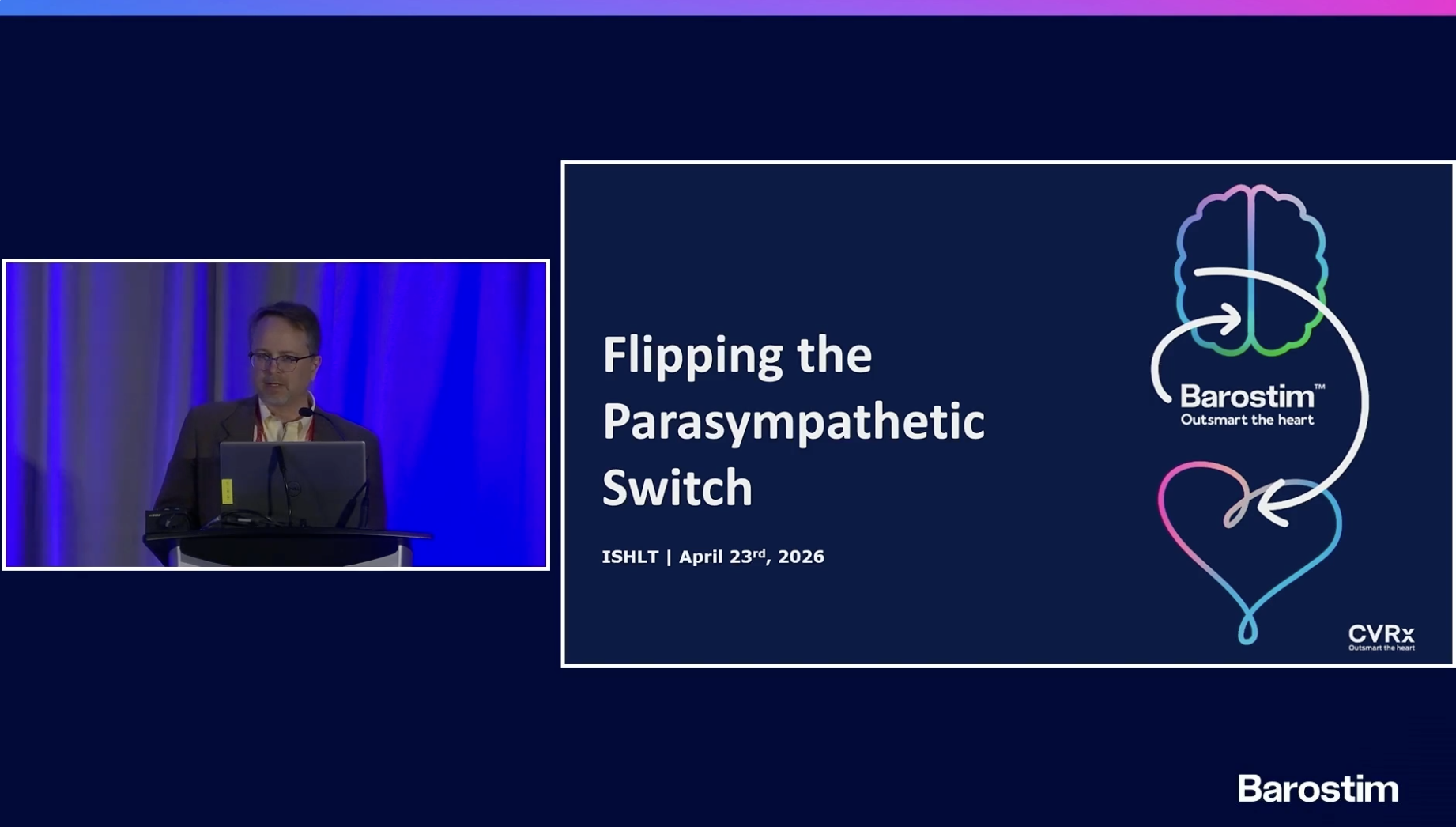
Barostim: Flipping the Parasympathetic Switch at ISHLT 2026

Conferences
Outsmarting the Heart at ISHLT 2025
Conferences
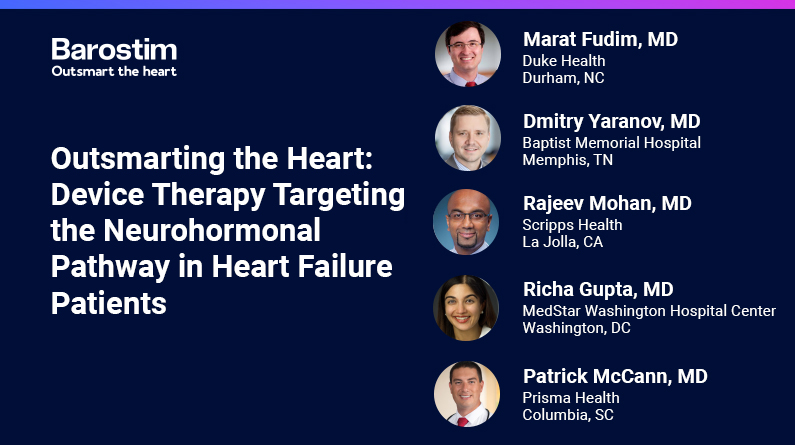
Device Therapy Targeting the Neurohormonal Pathway in Heart Failure Patients
The website you are about to access may be governed by different regional policies, regulations or advertising codes. Please be sure to read the privacy notice, cookie notice and terms of use of the websites that you visit.
CVRx is not responsible for the accuracy or compliance with laws of information on any third party websites.
Do you wish to proceed?