
Clinical Evidence
In the BeAT-HF trial, Barostim resulted in significant and sustained improvements in both heart failure-specific and general quality of life parameters over 24 months.1
Many patients suffering from heart failure (HF) symptoms value quality of life (QoL) improvement over longer survival2 and are risk tolerant to device therapy.3 Therefore, QoL is a critical factor in the shared decision making between the patient and physician in HF management. In the BeAT-HF trial, 24-month QoL data were compared between patients receiving Barostim and patients receiving usual care medical management using two complementary tools:
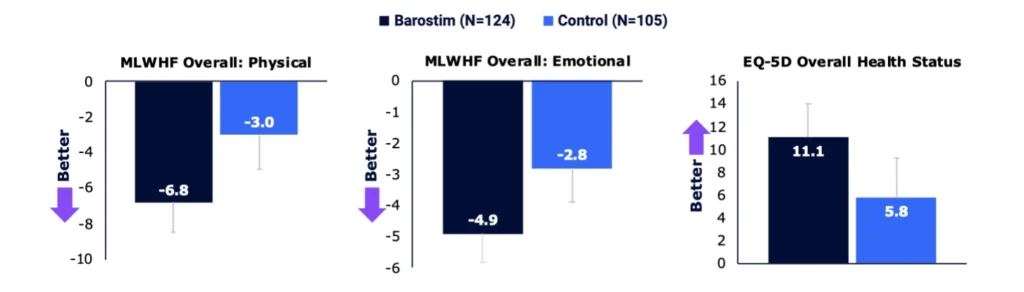
In patients suffering from HF symptoms, Barostim resulted in sustained improvements in a variety of physical and psychosocial measures compared to usual care medical management alone. Patients receiving Barostim reported significant improvement in their ability to perform usual activities and feeling less shortness of breath, fatigue, depression, and pain/discomfort. These long-term QoL benefits support the shared decision making of patients and physicians when considering Barostim therapy.
Listen to the podcast.
CAUTION: Federal law restricts this device to sale by or on the order of a physician. See Instructions for Use 900133-001 for a complete instruction for use and a description of indications, contraindications, warnings, precautions and adverse events.
The Barostim System is indicated for patients who are NYHA Class III or Class II (who had a recent history of Class III) despite treatment with guideline-directed medical therapies (medications and devices), have a left ventricular ejection fraction of ≤ 35%, and a NT-proBNP <1600 pg/ml. Barostim delivers Baroreflex Activation Therapy for improvement of patients' heart failure functional status, six-minute hall walk, and quality of life.
Patients are contraindicated if they have bilateral carotid bifurcations located above the level of the mandible, baroreflex failure or autonomic neuropathy, uncontrolled symptomatic cardiac bradyarrhythmias, carotid artery stenosis greater than 50% caused by atherosclerosis, as determined by ultrasound or angiographic evaluation, ulcerative plaques in the carotid artery as determined by ultrasound or angiographic evaluation, known allergy to silicone or titanium.
Warnings include: only trained physicians may use this system, prescribing physicians should be experienced in the diagnosis and treatment of heart failure and should be familiar with the use of this system, blood pressure and heart rate should be monitored during Carotid Sinus Lead placement and when adjusting stimulation parameters intra-operatively, system programming post-implantation, should avoid the following: heart rate falls below 50 beats per minute (BPM), or systolic pressure falls below 90 mmHg, or diastolic blood pressure falls below 50 mmHg, or problematic adjacent tissue stimulation is noted, or undesirable interaction indicated by monitoring of any other implanted electrical device, or any other potentially hazardous patient responses are observed. For patients who currently have an implanted electrical medical device, physicians must verify compatibility with the implanted device during implantation of the system as well as whenever settings are changed in either implant. Interactions are more likely in devices that contain a sensing function, such as an implantable cardiac defibrillator or pacemaker. If an interaction is observed, the Barostim NEO and NEO2 should be programmed to reduced therapy output settings in order to eliminate the interaction. If necessary, change settings in the other implant only if the changes are not expected to negatively impact its ability to perform its prescribed therapy. During the implant procedure, if device interactions cannot be eliminated the Barostim System should not be implanted. Improper system implantation could result in serious injury or death. Do not use diathermy therapy including shortwave, microwave, or therapeutic ultrasound diathermy on patients implanted with the system. Patients should be counseled to stay at least 15 cm (6 inches) away from devices with strong electrical or magnetic fields such as strong magnets, loudspeaker magnets, Electronic Article Surveillance (EAS) system tag deactivators, arc welders, induction furnaces, and other similar electrical or electromechanical devices. This would include not placing items such as earphones in close proximity to the implanted pulse generator. The system may affect the operation of other implanted devices such as cardiac defibrillators, pacemakers, or neurological stimulation systems.
Precautions include: the system should be implanted and programmed carefully to avoid stimulation of tissues near the electrode or in the area of the IPG pocket. Such extraneous stimulation could involve the following: the regional nerves, causing laryngeal irritation, difficulty swallowing, or dyspnea, the cervical musculature, causing intermittent contraction, skeletal muscles, causing intermittent contraction around the IPG pocket. Proper sterile technique during implantation should be practiced and aggressive pre-operative antibiotics are recommended. Infections related to any implanted device are difficult to treat and may necessitate device explanation.
It is anticipated that subjects will be exposed to operative and post-operative risks similar to related surgical procedures involving the neck and/or a pacemaker implant. These risks and potential risks of chronic device based Barostim may include, but are not limited to: stroke, transient ischemic attack (TIA), systemic embolization, surgical or anesthetic complications, infection, wound complications, arterial damage, pain, transient, temporary or permanent nerve damage/stimulation, hypotension, hypertensive crisis, respiratory, exacerbation of heart failure, cardiac arrhythmias, tissue erosion/IPG migration, injury to baroreceptors, fibrosis, allergic reaction, general injury to user or patient, need for reoperation, secondary operative procedure, and death. Patients implanted with the system may receive Magnetic Resonance Imaging (MRI) only when all MR Conditional safety parameters are met as listed in the instructions for use.
CVRx, Barostim, BAT, Barostim NEO, Barostim NEO2, BATwire, Outsmart the heart, and Barohub are all trademarks of CVRx, Inc. © 2026 CVRx, Inc. All rights reserved. All other trademarks are property of their respective owners.
For a list of all potential benefits and risks go to www.barostim.com/benefit-risk-analysis/
For a list of all applicable patents, see www.barostim.com/patent-marking.